Research at AITHYRA
“Our mission is to transform life science with the help of AI to improve human health.”
Research Vision
AITHYRA is founded at a historical moment where progress in life sciences is frequently stymied by complexity, and computational science is constrained by formalism. We believe that AI offers a new lens that can recognize biological patterns too vast or subtle for human intuition and thereby inductively derive models without requiring explicit laws. At AITHYRA, we are convinced that a coherent integration of AI and life science research is required to address the big biomedical challenges of our time. We envision a future where biological research will be conducted by humans in continuous collaboration with intelligent systems. AITHYRA strives to develop an environment where AI does not just analyze data but instead supports researchers to develop hypotheses and to propose new experiments. In many instances, these experiments will be executed at scale, leveraging autonomous experimental platforms which produce data that can directly be fed into AI/ML models. By taking leadership in this new research paradigm, AITHYRA aspires to become a globally recognized hub for AI-driven life science where fundamental structural and functional principles across biological scales can be learned, predicted, and applied to improve our ability to understand, diagnose and treat diseases. To reach this goal, research at AITHYRA will be conducted in close collaboration between computer scientists, biologists, chemists, engineers, and medical doctors and involve AITHYRA core principal investigators (PIs) as well as Global Adjunct PIs and a wide network of international collaboration partners.
Integrated Research Areas
Defining the future of biomedical AI through cutting-edge research


Life Sciences
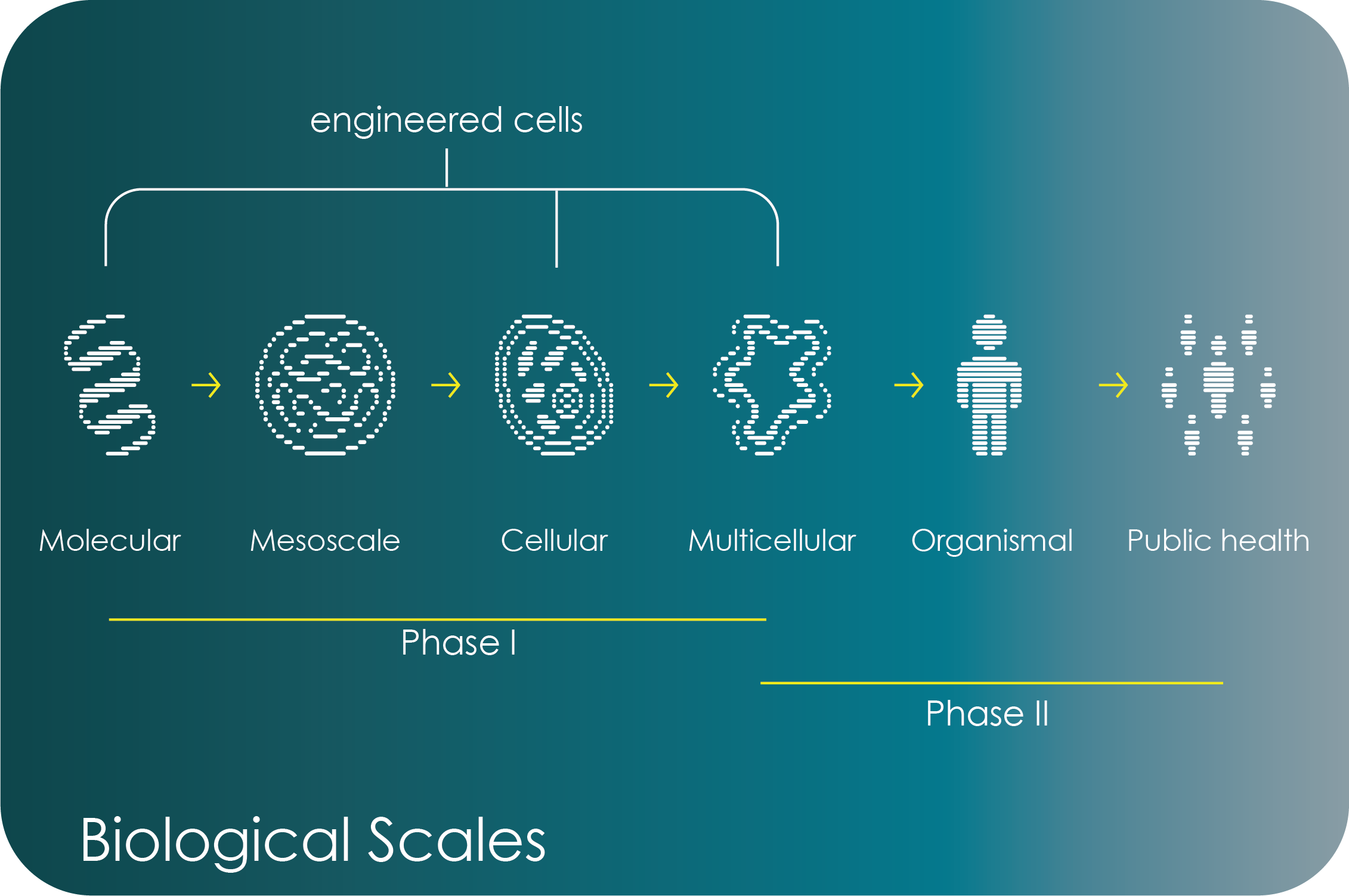
At AITHYRA, we will pursue research questions that span biological scales, reaching from topics at the molecular scale to questions of public health. This broad reach will be built in two Phases. Our current focus is on Phase I, ranging from the molecular to the tissue/organoid scale.
PIs at AITHYRA are, for instance, interested in designing small molecules and proteins, in engineering enzymes, in structural virology and general aspects of the host-pathogen conflict and in spatial and temporal aspects of cellular communication.
At AITHYRA, we believe that coherent integration of AI and life science will increasingly enable the age of programmable biology where the function of molecules, biological circuits, cells and tissues can be decoded, modeled and rewritten using AI and scalable, high-throughput experimentation. We want to apply this concept on two complementary lines of research. Following a “build to understand” mentality, we want to leverage programmable biology to gain new insights into fundamental aspects of life, ranging from questions in molecular recognition to cellular and tissue organization. Based on the same principles of programmable biology, we want to reimagine therapeutic innovation and design. In particular, we want to shape a radically new way of how therapies are conceived. We want to deliberately reach beyond the conventional inhibitor-based loss-of-function principles to ultimately empower new types of therapies. These drugs will be designed to rewire and reprogram (rather than just block) disease-causing biological circuits and can manifest as small molecules, proteins or engineered cells.
We are building an AI native, closed loop research engine where automation, computation, and intelligent agents work in seamless collaboration. At its core is a modular, programmable environment built for scientific flexibility, allowing for rapid scientific ideation to physical execution loop. The platform is designed for true scientific flexibility, built from adaptive automation systems that include vision enabled liquid handlers, self-teaching robotic arms, and sensor rich work cells that provide critical environmental data alongside large-scale experimental execution. An AI driven orchestration layer coordinates these components and activities, adapting to the complexity and uncertainty of a dynamic laboratory.
Scientists will work alongside AI copilots that translate hypotheses into digital SOPs, orchestrate complex workflows across robotics, software, and experimental hardware, and generate and interpret data in real time, learning from every experimental cycle and guiding the next steps with increasing precision. The platform can be dynamically reconfigured and executed, not just by engineers but by scientists, to run anything from simple protocols to advanced lab in the loop workflows, enabling researchers to move fluidly between manual exploration, assisted experimentation, and fully autonomous execution, at the pace their science requires.
With each cycle, the system integrates new data to refine predictions, improve experimental design, and reveal deeper biological insight, creating a continuous learning loop. As a result, the lab becomes a reliable, high throughput partner that accelerates iteration speed, increases reproducibility, and empowers AITHYRA teams to pursue complex biological questions with greater precision and scale.
Building and maintaining the AI-driven robotics lab: To support the construction, maintenance and continuous improvement of Aithyra’s AI-driven robotics lab, Wali Malik, an experienced Head of Lab Automation, will oversee operations and build and manage a team of 5-7 members with a diverse background in automation and software development. The development of the platform will happen in two stages. In Phase I, an initial robotics lab will be built using ~100m2 lab space in the Marxbox. Full platform development will occur in Phase II in Aithyra's purpose-built research building with 400m2 dedicated lab space.
We now live in an era when, for the first time in the history of science, hypothesis generation can be delegated to a machine. Recent examples show the first success of AI systems in tasks that typically require human creativity and logic, such as theorem proving and competitive programming. Adding to the previous success of AI in traditionally human creative tasks such as creative writing and art, these breakthroughs signal a profound change: machines are no longer just tools to implement human ideas but active participants and partners in generating new knowledge.
As Aithyra develops increasingly sophisticated AI/ML models across biological scales, the need for interpretable AI becomes strategically central. Many of the most impactful collaborations in the life sciences, particularly with experimentalists and clinicians outside of Aithyra, hinge not only on model performance but on the ability to understand and trust how predictions are made. Interpretable models leveraging learning techniques on knowledge graphs, causal learning, neuro-symbolic approaches, physics-inspired neural networks, or post hoc explanation techniques can serve as critical bridges between data-driven inference and mechanistic biological insight. To maximize the likelihood of early impact and sustained differentiation, Aithyra is strategically deprioritizing a number of otherwise important technologies and research areas that are currently less aligned with the AI-native model of scientific discovery.